Friday, December 28, 2018

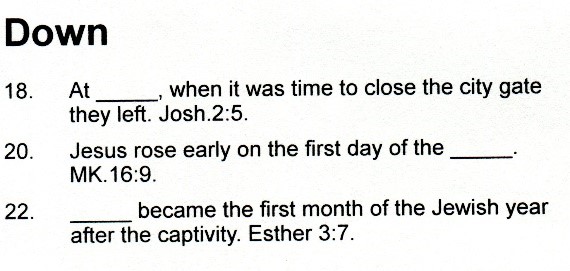
Calendar & Seasons Crossword


The Last Remembrance Meeting


        The “Breaking of Bread” (often called The Lord’s Supper or Communion or Remembrance) is the distinctive, it’s the defining characteristic of an assembly. Remember that the Lord instituted this service as they were celebrating Passover. And Passover always involved the death of a lamb. There is no mention of “roast lamb” at the Last Supper. But, as Christians, we know that there was a Lamb there, and about to die.
        That first Breaking of Bread, as we would call it, was unique in many ways. Jesus was there in Person, with only the Eleven (after Judas left), while there were other believing men right there in Jerusalem, who could have attended, such as Nicodemus or Joseph of Arimathea, or Joseph Barsabbas or Matthias. There were, apparently, no women present. The day of the week was, by our reckoning, Thursday.
        It seems that the second Breaking of Bread occurred the very next Sunday (i.e., the first day of the week): “There they found the ‘Eleven’ and those with them, assembled together…Jesus himself stood among them.” (Luke 24:33, 36) The resurrected Christ appeared in their midst. But Thomas wasn’t there.
        The third Breaking of Bread happened on the following Sunday: “A week later his disciples were in the house again, and Thomas was with them.” (John 20:26) Again, Jesus appeared in Person, and showed them, including Thomas, His wounds.
        Again and again through the New Testament, the Lord’s people met on the first day of the week to Break Bread, to remember the Lord’s death, and to look forward to His return. Now they knew Him by faith, not by sight. See Acts 20:7, and 1 Corinthians 16:2.
        Down through the centuries, God’s people have continued this practice in some form or other, of memorial, worship, bread and wine, and anticipation. And for all these years it has still been “by faith not by sight.”
        So when will that last Breaking of Bread take place? When comes that final communion? I think it may be described in Revelation 5:6-14. There, again, is the Lamb from the Passover, the One about to be slain after the Last Supper, now slain but alive. He stands in the centre of the throne and all worship comes to Him— millions of angelsand every creature in heaven and on earth cry— Worthy is the Lamb!”
        This is the last great Communion service, the last Remembrance meeting, because Jesus is now in the midst of His people in Person once again. He will never leave them! It is no longer faith alone, now at last, it is by sight!    

Come and Join the Song!


        I read recently of a gentleman who was trying out for a choir. The conductor would say, “Here is a chord of three, four or five notes; you can hear it all together, but can you hear the notes individually, and sing each in turn?”* Then the writer finished the chapter by saying, “How can we strike fresh chords so that people will be teased into picking out the notes, and perhaps even joining in the song?”
        An extreme but fun application of this idea is a video called He’s My Rescuer, by the Rend Collective from Belfast. See
It starts with the group reclaiming an old weed-infested piano in a field. Then it steps up the pace and we see the piano on a flat-bed wagon behind a gleaming red tractor. The band has joined the pianist on the wagon and the lead singer is driving. The song they sing as they go along is all about Jesus. By doing this, the people see and hear the commotion and a motley group joins in behind, even though they still have all sorts of baggage and props.
        So, the really big question is, how do we get the true story of Jesus out in front of the people? If the local church invited all their friends to the Family Bible Hour or the mid-week meeting, it would still be only a tiny percent of the city population. [At four friends per person, that is only about 350 people, or about 0.2% of the Burlington population.] If we advertise in newspapers or radio, the cost quickly becomes prohibitive. Not to mention the fact that if we invite, we had better have something powerful for them to hear or see.
        It isn’t obvious how to overcome these hindrances. If you’ve been following Colin Burnett’s Newsletters, you will have seen at least two different attempts that he has made in Ireland. He’s in this for real. One is a coffee morning for anyone who cares to drop in—free coffee, informal chat, and 5-16 attendees [“opportunity to share some spiritual truths”]. The other he calls “Café Church”—[Colin says, “Last year we retrofitted our general purpose room to a café style. On the last Sunday of the month we open the doors at 6:00 pm, folks come in and enjoy tea & coffee along with something to eat. While this is happening there is Christian music playing as well as scripture texts on the screen. At some point we may have a song or two, or a quiz. Near the end of the night there will be a short gospel message then time to sit around and chat. Of all the outreach works we have tried at the meeting, this has been the most productive as far as people coming along.”]
        What precedent do we have from Scripture? Are there any comparable situations? It seems, yes. Look at Acts 19:9. When the Apostle Paul was driven out of the synagogue in Ephesus, he rented the lecture hall of Tyrannus and met with all comers. He probably didn’t have coffee, but I’m sure he had some soda and a Domino’s pizza available. But he did have the advantage over us of doing “extraordinary miracles”.  I don’t think he was lecturing all the time either; I’m sure much of the time it was just one-on-one chats. This went on for two years. If no one showed up, Paul could work on his tents for some cash, or catch up on his correspondence or letter-writing (paper work). One way or another, Paul took great advantage of that lecture hall.                      
*Mark for Everyone by N.T.Wright, p.48 

He's My Rescuer   

                  There is good news for the captive, good news for the shamed.
                  There is good news for the one who walked away.
                  There is good news for the doubter, the one religion failed.
                  Oh, the good Lord has come to seek and save---He's my Rescuer.



The Breadth of Christian Literature


        On November 22nd, 1963, I was sitting in my home room class at Hillcrest High School in Port Arthur, when a classmate rushed into the  room and shouted, "Kennedy's been shot!" I've remembered that date and exactly where I was ever since. But two other men, whom I had never heard of at that time, died that same dayAldous Huxley and C.S.Lewis. Huxley was a vocal agnostic, but Lewis was a renowned Christian thinker. Being raised in a fundamentalist Christian church, how could I not have known C.S.Lewis?
        Looking back now, I realize that I suffered a great loss, at least as far as C.S. Lewis is concerned, and I don’t want that to happen again to anyone. His book, The Lion, the
Witch and the Wardrobe is a wonderful picture of Christ’s substitution for us, and in a way that a child can see. Mere Christianity has led many to Christ. And the essays in God in the Dock lead on to some thrilling insights into theology.
        Another positive change for me was to hear the exact words of Scripture set to music—Handel’s Messiah—breath-taking and worship-making!
        The list of books goes on: Knowing God by J.I.Packer helped bring a friend back from a life of discontent and disillusionment. Basic Christianity by John R.W.Stott was so direct that I wondered how anyone could read it and not become a Christian on the spot! And his book on The Cross of Christ is a monumental classic.
        Moving into current times, take a look at some of Timothy Keller’s works: He names his books in apparently paradoxical ways, but their insights into evangelism and Christian growth are priceless: The Prodigal God, The Reason for God, and Generous Justice.
        If you’re looking for some clear, informed thinking on science, John Lennox delivers: Seven Days That Divide the World, and God’s Undertaker.  Alister McGrath is another writer on church history and science: Knowing Christ, and The Dawkins Delusion?.
        The list could go on and I’ve hardly even touched on fiction. I have to admit that my reading tastes aren’t very wide-ranging. Let me mention one final author whom I have very much enjoyed:  Lee Strobel and his books and videos: The Case for Christ, The Case for Faith, The Case for a Creator.
        The upshot of all these lists is that there is wonderful spiritual blessing to be had from the great literature of many, if not most, Christian traditions. Praise God for everything that Augustine, Luther, Calvin, the Puritans, Bunyan, and many others have left for us to read.

Sunday, October 28, 2018

“Apologetics…for discussion…”


        The January/February 2018 issue of this Newsletter carried the above article relating to the ages of the patriarchs. We were very pleased to receive from Arthur Dixon, a three-page commentary on its details. This is too long to include here but we have posted copies on the bulletin board and made it available at the following address:


        This subject is still “open for discussion”, but a brief summary of Arthur Dixon’s comments is as follows:—
        God created “the heavens and the earth” in six normal 24-hour days. The genealogies of Genesis 5 and 11 are exact and accurate, and do not “skip” any generations. Noah lived contemporaneously with Abraham for 58 years.
        Creation dates calculated by some famous scientists (e.g., Newton, Kepler) and historians (e.g., Ussher) range from 3992 BC to 4114 BC. Finally, “the historicity of the physical lines of descent, from the first Adam to the last Adam, our Lord Jesus Christ, is fundamental to redemptive history. Without it, we have no kinsman Redeemer, no substitutionary Atonement, no Saviour.”

The Florida Mangrove’s Yellow Leaf


        On a swamp boat tour in Florida, our guide introduced us to a wonder of God's creation. The marshes and swamps on the Florida coast are a unique ecosystem. Since the swamps are salt water, not many plants can survive in this environment. (Try dumping salt water on your house plants!)
        The red mangroves grow in the silt and salt water of the swamps. The roots, appropriately called "prop roots" help to bolster the land and protect it from erosion. The roots accumulate silt, fallen leaves and plant material that can shelter and allow for habitats for baby sharks, fish, sea stars and other marine wildlife. Because of their strong root structure this nurturing ecosystem protects the land from strong currents, hurricanes and erosion, slowly building higher ground.
        This unusual environment causes a unique problem— how to get rid of the salt?
        This is where God's plan comes into action. If you look at a mangrove tree, you will see that most of the leaves are green but there will always be at least one bright yellow leaf. All the salt and other impurities are being forced into these yellow "sacrificial" leaves. Taking the salt of the entire tree into themselves, they eventually turn yellow, die and fall off, so the rest of the tree can live!
        Jesus took all our sins and impurities upon Himself. The mangroves have to continually sacrifice these yellow leaves. But Jesus died “once for all” (Romans 6:10). No more sacrifice is needed because Christ, though He was sinless, paid the price for all our sins, once and forever. As Jesus said on the cross... "It is finished." (John 19:30) Nothing more is required.

How much bread might they get?


        Philip answered him, “It would take more than half a year’s wages to buy enough bread for each one to have a bite!”  John 6:7

        Early in September I found Wonder white bread on sale at Fortino’s for $1.99 per 675-gram loaf. I counted to find how many slices—19—expecting that we were talking a slice or two each. Then I guessed at an average salary of $40,000. This means that half a year’s wages would be $20,000 and, in Philip’s estimation, each of the 5000 men would get about two modern loaves.
        This means that Philip was slightly exaggerating the amount each would get as “a bite”. But it also means that food, in particular, bread, cost a much higher percentage of a person’s income then than it now does.